
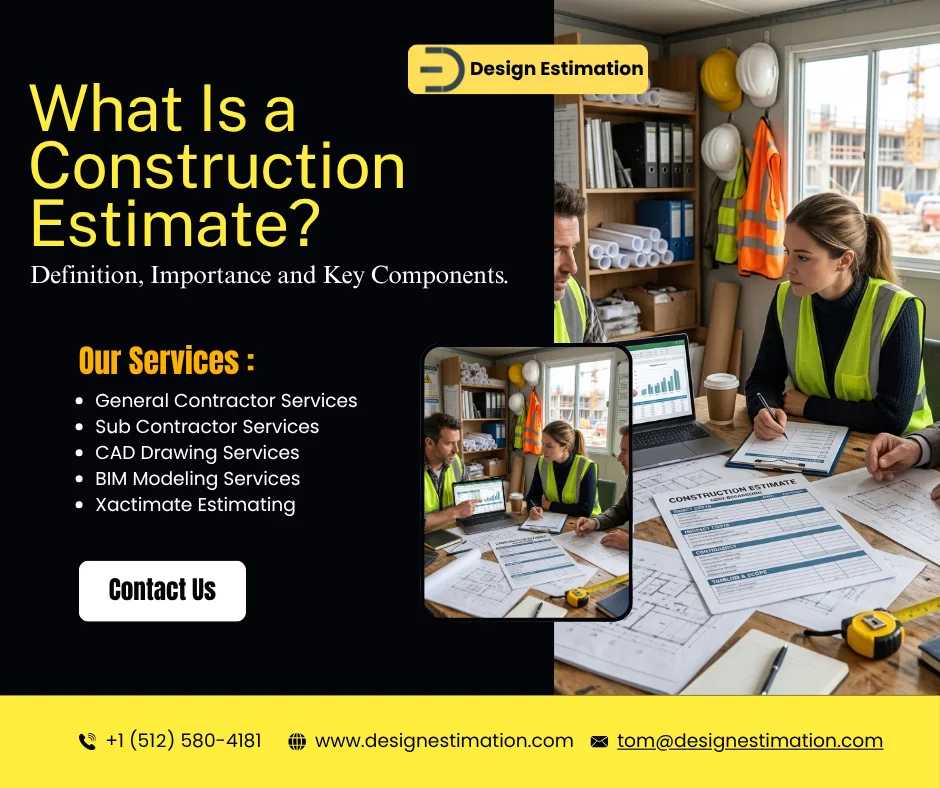
Every construction project starts with someone asking “how much will it cost?” The estimate is the answer, and how good that answer is decides whether the project gets funded, whether the contractor makes money, and whether the owner gets surprised halfway through. This guide explains what a construction estimate is, why it matters, what it should include, and how it differs from a quote or a bid. It is part of our complete guide to construction cost estimation.
Construction Estimate Definition
In construction, an estimate is a calculated prediction of the cost of a project or part of a project, prepared before the work is done. Construction estimating is the process of preparing it: measuring the work, pricing it and documenting the assumptions. A construction cost estimate is the resulting document.
The word “estimate” can sound loose, but a professional estimate is not a guess. It is built from measured quantities and known prices, and it shows its work so that anyone reviewing it can follow how each number was reached. What makes it an estimate is that some inputs are still uncertain: final material prices, field conditions and how productive crews will be.
What Is a Cost Estimate in Construction Used For?
| Who | Why they need an estimate |
|---|---|
| Owners and developers | To decide whether a project is worth building, secure financing and set the budget |
| Architects and engineers | To keep the design within budget and compare design options |
| General contractors | To price bids, plan the work and track costs during construction |
| Subcontractors | To price their trade scope accurately and profitably |
| Lenders and insurers | To confirm the loan or coverage amount matches the real cost of the work |
Importance of Cost Estimation in Construction
- It decides whether a project happens. Projects are approved, financed or cancelled based on the estimate.
- It protects the contractor’s profit. A missed quantity or wrong labor rate comes straight out of margin. See how accurate estimates protect your profit margin.
- It drives the design. Early estimates show which systems and finishes the budget can support.
- It makes bids comparable. Owners can compare contractors fairly when estimates are itemized on the same scope.
- It sets the baseline for cost control. After award, the estimate becomes the budget the project is measured against.
- It supports scheduling and cash flow. Quantities and labor hours feed the schedule and the payment forecast.
- It reduces disputes. Clear scope, inclusions and exclusions prevent arguments about what was priced.
What Should a Contractor Estimate Include?
A complete contractor estimate covers both the cost of the work and the terms it is based on:
| Section | What to include |
|---|---|
| Project details | Project name, address, client, drawing set and revision, estimate date |
| Scope of work | A clear description of what is included, by trade or CSI division |
| Cost breakdown | Materials, labor, equipment and subcontracts for each division |
| General conditions | Supervision, temporary facilities, cleanup, permits, insurance |
| Markups | Overhead, profit, bonds and contingency |
| Allowances | Amounts carried for items not yet selected, such as fixtures or finishes |
| Alternates | Priced options the owner can add or deduct |
| Exclusions | Work not included, such as permits, testing, utility fees or furniture |
| Assumptions | Site conditions, working hours, access and anything else the price depends on |
| Validity and terms | How long the price is good for, payment terms and how changes are handled |
See a full sample in our general contractor estimate examples, including a template layout you can copy.
Construction Estimate Terms and Conditions
The terms on an estimate or proposal matter as much as the numbers. Common ones include:
- Price validity: for example, valid for 30 days, because material prices change.
- Payment terms: deposit, progress payments, retainage and final payment.
- Change orders: how added or changed work is priced and approved.
- Allowance reconciliation: how the final cost of allowance items is adjusted up or down.
- Escalation clause: how large material price increases are handled on long projects.
- Unforeseen conditions: what happens if hidden conditions, such as rock or rot, are found.
- Warranty: what is covered and for how long.
These terms are commercial and often legal commitments, so contractors should have their standard proposal terms reviewed by an attorney.
Estimate vs. Quote vs. Bid vs. Proposal
| Term | What it means | Binding? |
|---|---|---|
| Estimate | An approximate cost based on the information available | Usually not binding; may change as details are confirmed |
| Quote | A fixed price for a defined scope, often from a supplier or subcontractor | Generally binding for the stated period |
| Bid | A formal price submitted in response to bid documents, usually in competition | Binding once accepted, under the bid terms |
| Proposal | The document presenting the price, scope, terms and schedule to the client | Becomes binding once signed or incorporated in a contract |
In everyday use these terms overlap. The contract language is what determines what is binding.
Types of Construction Estimates (Overview)
Estimates evolve with the design, from a quick order-of-magnitude number to a fully detailed estimate. The main types are order of magnitude, conceptual, preliminary, detailed, bid and control estimates, and many owners label them Class D to Class A. Our guide to types of construction cost estimates compares each one, with accuracy ranges.
Who Prepares Construction Estimates?
Construction estimators prepare most estimates, either on a contractor’s staff, for an owner, or at an independent estimating firm. On larger projects, quantity surveyors and cost consultants prepare estimates for the owner, and project managers maintain the control estimate during construction. A good estimator combines construction knowledge, careful measurement and an understanding of how crews actually work.
How a Construction Estimate Is Prepared
In short: review the drawings and specs, visit the site, do the quantity takeoff, price the materials, labor and equipment, collect subcontractor quotes, add general conditions and markups, and check the result. Our step-by-step construction estimating for beginners guide walks through each step with a worked example.
Need a Construction Estimate?
Design Estimation prepares detailed construction estimates and quantity takeoffs for general contractors, subcontractors and developers, organized by CSI division and delivered in 24 to 48 hours on most projects. View our estimating services or send your plans for a quote.
For the full overview of estimate types, methods, costs and common mistakes, see our construction cost estimation guide.
Share This Entry
Frequently Asked Questions
Quick answers to the questions contractors ask us most.
What is a construction estimate?
A construction estimate is a calculated forecast of the cost to build a defined scope of work. It covers materials, labor, equipment, subcontracts, general conditions, overhead, profit and contingency.
What is the meaning of estimating in construction?
Estimating in construction is the process of measuring the work from the drawings and pricing it before construction starts. The result is the cost estimate used for budgets and bids.
Why is cost estimation important in construction?
It decides whether projects get built, protects the contractor’s profit and sets the budget for cost control. Errors in the estimate carry through the whole project.
What should a contractor estimate include?
Scope, a cost breakdown, general conditions, markups, allowances, exclusions, assumptions and terms. It should also say how long the price is valid and how changes are handled.
Is a construction estimate legally binding?
An estimate is usually not binding on its own, but a signed proposal or contract based on it is. The wording of the document and the contract decides, so read the terms carefully.
What is the difference between an estimate and a quote?
An estimate is an approximate cost; a quote is a fixed price for a defined scope. Quotes are common from suppliers and subcontractors, while estimates are common early in a project.
How much does a construction estimate cost?
Many contractors provide estimates free when bidding, while detailed estimates from independent estimators are paid services. The fee depends on project size, the number of trades and how quickly it is needed.
Related Articles
 Articles · 16 min readConceptual Estimate in Construction: 2026-27 Pro GuideRead Article →
 Articles · 10 min readConstruction Estimating for Beginners: How to Build Your First EstimateRead Article →
 Articles · 10 min readTypes of Construction Cost Estimates: From Conceptual to DetailedRead Article →
 Articles · 10 min readTypes of Construction: Project Sectors and IBC Type I to V ExplainedRead Article →
 Articles · 7 min readAcoustical Ceiling Takeoffs: How to Estimate Grid, Tile and CloudsRead Article →
 Articles · 2 min readConstruction Project Management Services: What Contractors Need From Preconstruction to CloseoutRead Article →
Get a Bid-Ready Estimate in 24–48 Hours
Send your drawings and bid date. We'll confirm scope, price and delivery time before any work starts.