
Construction Estimating Services in Pennsylvania — Philadelphia & Statewide Takeoffs
Design Estimation delivers location-calibrated material takeoffs, MEP cost calculations, and commercial bid preparation tailored specifically to Pennsylvania Uniform Construction Codes (PA UCC), local union/open-shop labor dynamics, and Mid-Atlantic climate conditions.
Statewide Market Landscape & Local Calibration
Pennsylvania’s commercial construction market is one of the most structurally diverse in the Mid-Atlantic — a mix of dense urban high-rise work in Center City Philadelphia, heavy industrial and healthcare construction across Allegheny County, warehouse and logistics development along the Lehigh Valley’s I-78/I-81 corridor, and retail, agricultural, and multi-family growth across Central Pennsylvania. General contractors, construction managers, and specialty subcontractors bidding across these four regions are working against tight margins, volatile material pricing, and jurisdiction-specific code and labor conditions that shift meaningfully from one county line to the next. A quantity takeoff built on national average unit costs does not hold up in this environment. Winning and protecting a bid in Pennsylvania requires an estimate calibrated to the specific municipality, labor market, and code jurisdiction the project sits in.
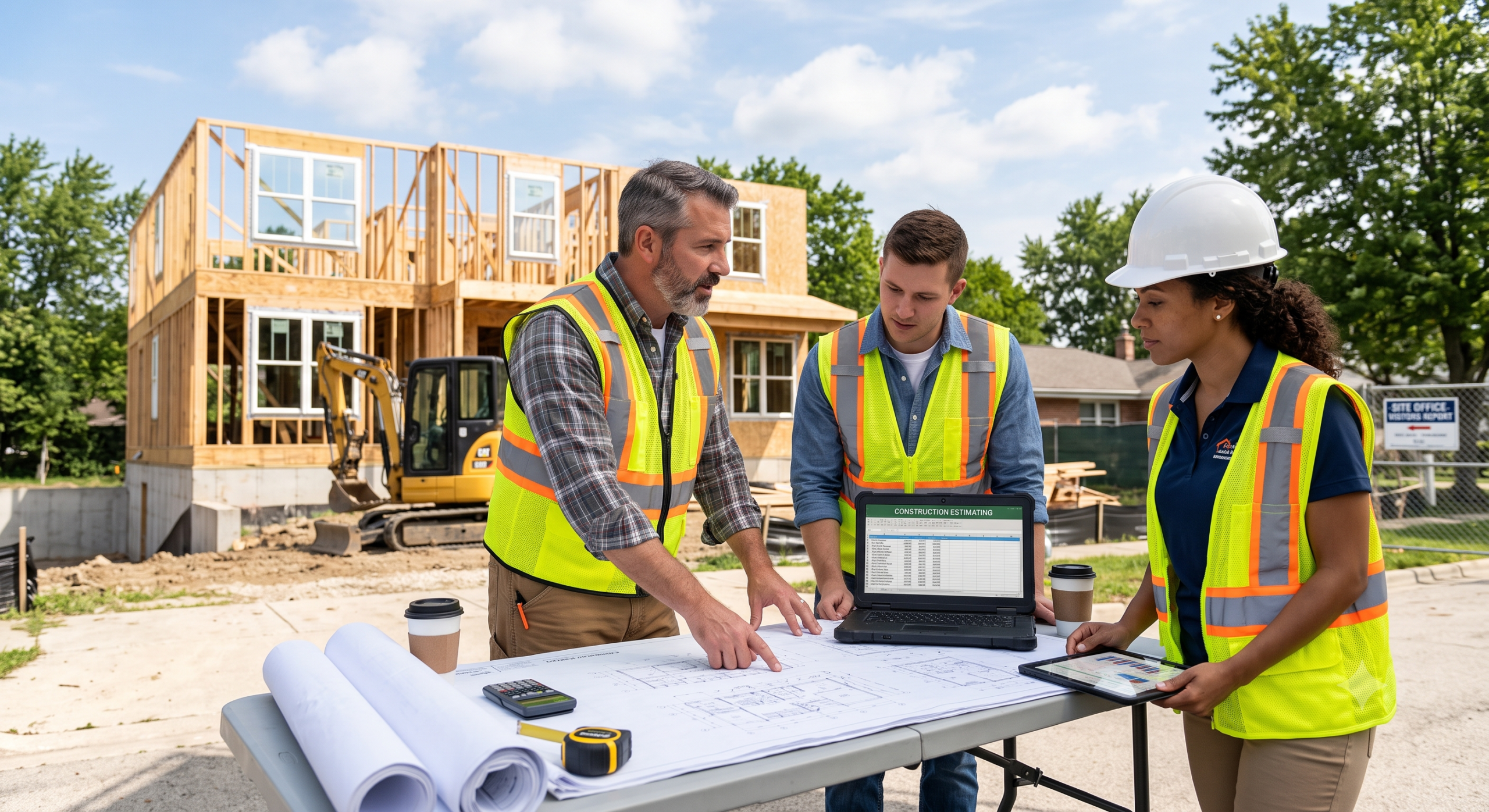
Construction Estimating Services in Pennsylvania delivered through Design Estimation cover location-calibrated quantity takeoffs across all 49 CSI MasterFormat divisions, from Division 1 general requirements and Division 2 existing conditions and demolition through Division 31 earthwork, Division 32 exterior improvements, and Division 33 utilities. Every takeoff is built from architectural, structural, MEP, and civil drawing sets and cross-referenced against Pennsylvania-specific material pricing, regional labor productivity factors, and local freight and delivery conditions — not a generic statewide average. Pennsylvania Construction Material Takeoffs produced under this scope account for supplier lead times out of the Philadelphia and Pittsburgh distribution markets, county-level permit and impact fee structures, and the material cost differential between union-shop procurement in the eastern and southwestern metros versus open-shop procurement in the Lehigh Valley and Central Pennsylvania.
Regional code and labor conditions drive real cost variance across the Commonwealth. The Pennsylvania Uniform Construction Code (PA UCC), administered by the Department of Labor & Industry, governs commercial construction statewide, with over 90% of Pennsylvania’s 2,562 municipalities electing to administer and enforce the code locally rather than defaulting to direct L&I enforcement — meaning plan review timelines, inspection sequencing, and local amendments differ by jurisdiction even under the same statewide code. Prevailing wage scales under the Pennsylvania Prevailing Wage Act apply to public construction contracts exceeding $25,000, with wage determinations issued by county and craft classification by the Department of Labor & Industry’s Bureau of Labor Law Compliance, layered on top of federal Davis-Bacon requirements on any federally funded work.
Labor burden assumptions also shift by region: Philadelphia and Pittsburgh remain strongly organized markets, with the Philadelphia Building & Construction Trades Council and the Allegheny County-area building trades unions representing the majority of commercial craft labor on institutional and high-rise work, while the Lehigh Valley and Central Pennsylvania markets carry a heavier open-shop and merit-shop presence, with ABC Keystone-affiliated contractors competing directly against union-shop bidders on distribution and light-industrial projects. An estimate that does not reflect the correct labor structure for the bidding market will misstate both direct labor cost and general conditions.
Pennsylvania’s climate also drives measurable line-item cost in two divisions specifically. Division 3 Concrete work must account for regional frost depth, which ranges from 30 inches in Philadelphia to 36 inches in Pittsburgh and Allentown and up to 42 inches across the state’s northern tier, along with air-entrainment requirements under ACI 318 exposure classes for freeze-thaw durability and cold-weather placement protocols under ACI 306 during the state’s four- to five-month cold-weather construction season. Division 7 Thermal and Moisture Protection carries equivalent regional variance, since Pennsylvania spans IECC Climate Zones 4A, 5A, and 6A — driving different prescriptive R-value, continuous insulation, and vapor retarder requirements depending on whether the project sits in southeastern Pennsylvania, the Pittsburgh/Lehigh Valley/Central PA belt, or the far northern counties. A takeoff that treats these as flat statewide assumptions will consistently misprice foundation and envelope scope.
CSI MasterFormat CoverageDivision-Level Quantity Takeoffs & Technical Considerations
Quantity takeoffs are produced across the full range of CSI Divisions 1 through 33, with Pennsylvania-specific pricing, code, and productivity adjustments applied at the division level rather than layered on as a blanket regional multiplier.
| Division Range | Scope Summary | Pennsylvania-Specific Estimating Consideration |
|---|---|---|
| 00 – 01 | Procurement & General Requirements | PA prevailing wage documentation, bonding/insurance requirements by owner type, municipal permit fee schedules. |
| 02 | Existing Conditions & Demolition | Asbestos and lead abatement common in Philadelphia’s pre-1978 building stock and Pittsburgh’s industrial-era structures. |
| 03 | Concrete Work | Air-entrained mix design, frost-depth footing quantities, cold-weather placement general conditions. |
| 04 | Masonry Systems | Regional brick and CMU pricing, historic masonry restoration and tuckpointing common across Philadelphia. |
| 05 | Metals & Framing | Structural steel framing takeoffs, heavily represented in Pittsburgh industrial and institutional work. |
| 06 | Wood & Composites | Light-frame multi-family and mixed-use rough carpentry across Central PA and Lehigh Valley suburbs. |
| 07 | Thermal & Moisture Protection | Climate-zone-calibrated insulation, air barrier, roofing, and below-grade waterproofing quantities. |
| 08 | Openings & Glazing | Storefront and curtainwall systems for urban towers, commercial door and hardware schedules. |
| 09 | Finishes | Institutional and healthcare fit-out finish schedules, flooring, ceiling, and wall system takeoffs. |
| 10 – 14 | Specialties & Conveying | Elevator and conveying scope, which falls under direct L&I jurisdiction statewide regardless of municipal opt-out status. |
| 21 – 22 | Fire Suppression & Plumbing | Local water authority backflow and interceptor requirements layered on the 2021 IPC baseline. |
| 23 | HVAC & Mechanical | Hydronic and forced-air load estimating calibrated to zone-specific design temperatures. |
| 25 – 28 | Electrical & Automation | 2020 NEC compliance as referenced under current PA UCC electrical provisions. |
| 31 | Earthwork & Shoring | Rock excavation contingencies for Pittsburgh’s hillside topography, urban shoring for tight Philadelphia sites. |
| 32 | Exterior Improvements | Paving, site concrete, landscaping, and stormwater surface features. |
| 33 | Site Utilities | Site utility routing, stormwater management sized to PA DEP erosion and sedimentation control requirements. |
Core Regional Coverage Across Pennsylvania
Philadelphia Metro Area
Philadelphia Commercial Quantity Takeoffs cover Center City high-rises, University City healthcare/lab fit-outs, Navy Yard adaptive reuse, and suburban campuses in Bucks, Montgomery, Delaware, and Chester Counties.
Pittsburgh & Western PA
Specialized structural steel, health-care fit-out estimating (UPMC campus developments), robotics tech hubs, and complex rock excavation handling across Allegheny County’s steep topography.
Lehigh Valley Corridor
Large-footprint tilt-up and precast warehouse takeoffs along I-78/I-81, crane pick sequencing, extensive earthwork, and 36-inch frost foundation depth requirements in Allentown-Bethlehem.
Central Pennsylvania
Route 30/15/283 corridors serving retail centers, Type III/V wood-frame apartment developments, and specialized agricultural/processing facility takeoffs across Lancaster and Harrisburg.
Trade-Specific Code & Engineering Standards (PA UCC)
Effective January 1, 2026, the Pennsylvania Uniform Construction Code moved to the 2021 ICC code series (IBC, IMC, IFGC, IPC, IECC) referencing the 2020 National Electrical Code (NEC). Design Estimation incorporates these precise thresholds into line-item estimating:
Foundation & Frost Depth Engineering
- Variable Frost Lines: 30 inches in Philadelphia, 36 inches in Pittsburgh/Allentown, and up to 42 inches in northern tier counties directly influence concrete footing volumes.
- ACI 318 Air-Entrainment: Exposure classes F1–F3 mandate 5% to 8% entrained air mix designs for freeze-thaw durability.
- Cold-Weather Concrete (ACI 306): Heated enclosures, cure protection, and accelerators are priced as distinct line items across the 4–5 month cold season.
Thermal Envelope & Insulation (Division 7)
- Three IECC Climate Zones: Zone 4A (Southeastern PA), Zone 5A (Allegheny/Central/Lehigh), and Zone 6A (Northern tier) determine prescriptive continuous insulation (ci) and cavity R-values.
- Air Barrier & Testing: Continuous air barrier assemblies and blower-door commissioning are quantified based on local compliance paths.
- Snow Load Sizing: Roof membrane and tapered insulation quantities account for high ground snow loads in the Poconos, Laurel Highlands, and Erie snowbelt.
MEP & HVAC System Specifications
- Hydronic & Boiler Plants: Commercial load calculations utilize regional degree-day heating parameters across institutional facilities.
- 2020 NEC Electrical Baseline: Service entrance switchgear and distribution panels are evaluated alongside market lead-time volatility.
- Local Water Authority Rules: Plumbing takeoffs integrate local mandates like Philadelphia Water Department backflow and interceptor rules over standard IPC baselines.
Bidding a Commercial Project in Pennsylvania?
Send us your drawings and project specifications. Our senior estimators will review your scope and provide a fixed-fee quote within 30 minutes.
Send Blueprints for Fast Quote