
Picture a general contractor in Ohio building a budget for a small medical office. He prices every line from a national cost book and the estimate looks detailed and complete. The problem? He never adjusts the numbers for his city. His drywall and electrical lines come in low, his concrete comes in high, and the total ends up several percent off. On a $2 million job, that is real money.
Skipping the location adjustment is the most common mistake we see with RSMeans data. People treat it as a price list. It is not. It is a national baseline that you have to move to your location, your crew and your job conditions. Once you understand how that works, RSMeans becomes one of the most useful tools in estimating.
This guide walks through what RSMeans is, how the zip-code adjustment actually works, and where the data helps or hurts you on a real bid.
How this guide was prepared: Our estimators wrote this guide from the estimating work we do for contractors across the US. Austin Smith, our founder, reviewed it.
What RSMeans Data Actually Is
RSMeans is a construction cost database published by Gordian. It started as printed cost books decades ago and now lives mostly online. Owners, architects, government agencies, insurance adjusters and contractors all use it to price work before real quotes come in.
The 2026 data set comes in several books and online libraries, each built for a different kind of work. The main ones include:
- Building Construction Costs, the core unit-price data for commercial work
- Square Foot Costs, for early budgets by building type
- Assemblies Costs, which group many items into one system price
- Residential Costs, for homes and small light-frame projects
- Trade books for electrical, plumbing, site work, heavy construction and more
- Open Shop data for non-union labor markets
Each line item has a code that follows the CSI MasterFormat structure. So concrete sits in Division 03, finishes in Division 09, plumbing in Division 22 and so on. If you already know how a project manual is organized, RSMeans will feel familiar.
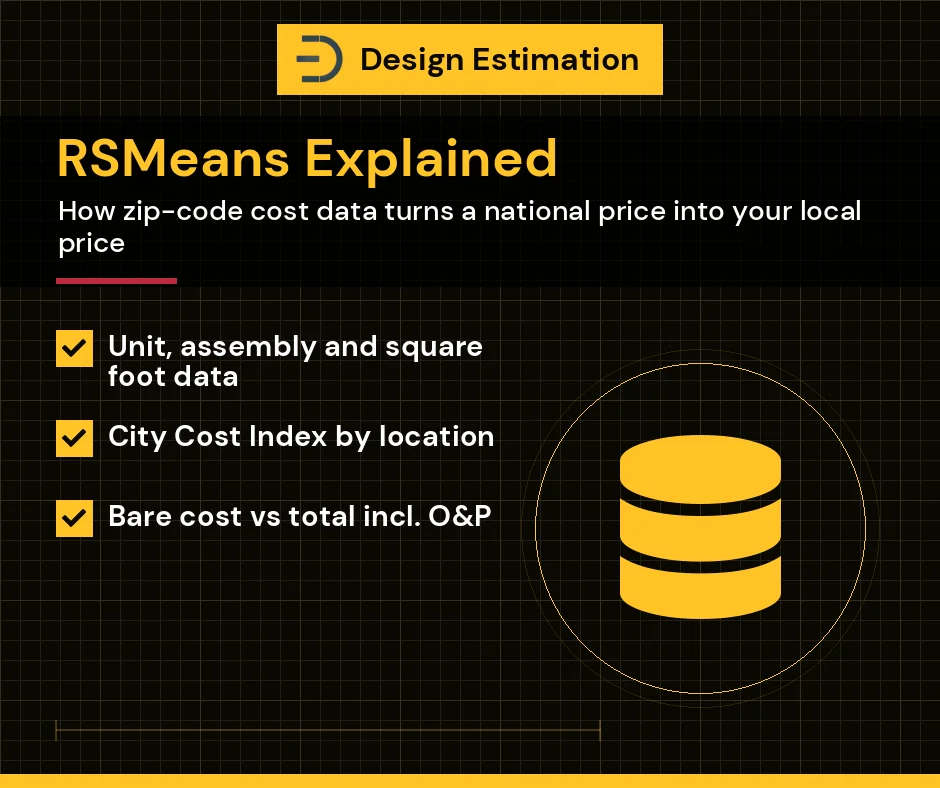
The Three Levels of RSMeans Data
Most people do not realize RSMeans gives you three different levels of detail. Picking the right level for the stage of the project matters more than anything else.
1. Unit costs
This is the most detailed level. A unit cost line covers one task, such as placing 4,000 psi concrete in a slab or hanging 5/8″ Type X drywall on metal studs. Each line shows the crew, the daily output, the labor hours per unit and the material, labor and equipment cost. You use unit costs when you have drawings and real quantities from a material takeoff.
2. Assembly costs
An assembly bundles many unit lines into one system. A wall assembly, for example, might include studs, drywall both sides, insulation, tape, finish and paint, all priced per square foot of wall. Assemblies are great at design development, when you know the wall types but not every detail.
3. Square foot costs
This is the fastest and least precise level. You pick a building model, such as a two-story office or a mid-rise apartment, and RSMeans gives you a cost per square foot. These models work well for feasibility studies and very early budgets. We talk more about choosing the right level in our guide to the types of construction cost estimates.
Rule of thumb from our desk: square foot costs for the go or no-go decision, assemblies for the design budget, unit costs for the bid. Mixing them up is how budgets go sideways.
How the Zip-Code Adjustment Works
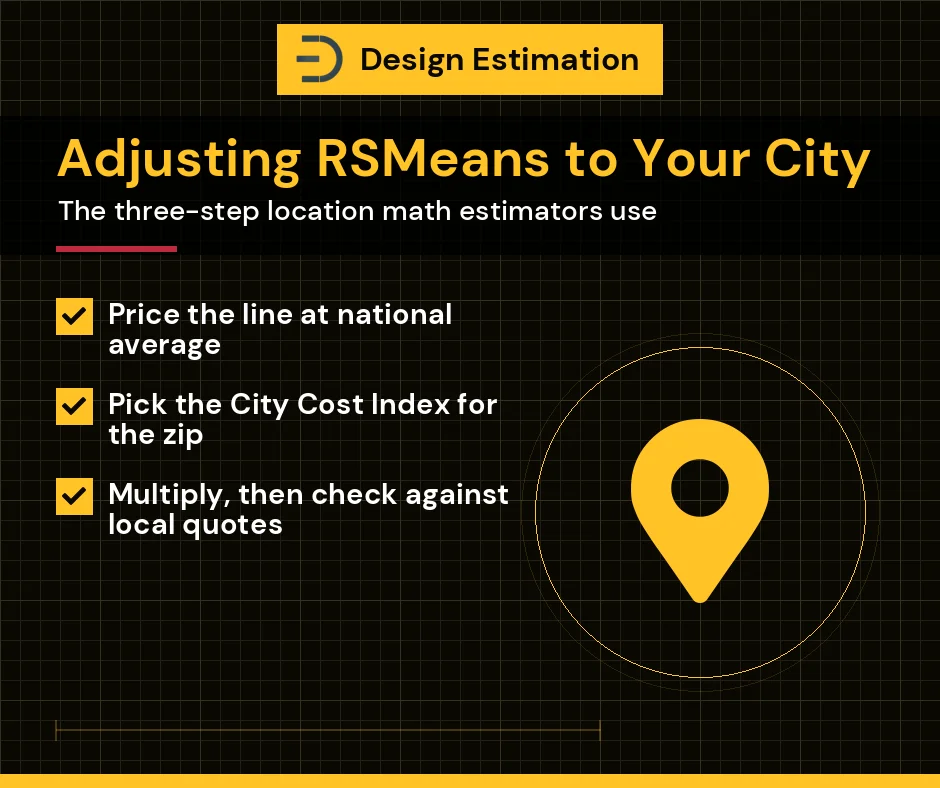
Every RSMeans price starts as a national average. To move it to your area, you use the City Cost Index, often called the CCI or location factor.
The CCI is a number based on 100. A city with a total index of 112 is about 12% more expensive than the national average. A city at 87 is about 13% cheaper. The index is split into a material factor and an installation (labor and equipment) factor, and it is broken out by division. That split matters, because labor costs swing much more from city to city than material costs do.
According to Gordian’s 2026 cost reporting, the research team collects prices from cities across the United States and Canada every quarter and updates the indexes on that cycle. Material prices come from manufacturers, dealers, distributors and contractors, and they exclude sales tax.
A simple worked example
Say a line item for interior partition framing comes to $10,000 at the national average, with $4,000 in material and $6,000 in installation. Your city has a material index of 102 and an installation index of 118.
- Material: $4,000 × 1.02 = $4,080
- Installation: $6,000 × 1.18 = $7,080
- Adjusted total: $11,160
If you had used a single blended index instead, you might have landed several hundred dollars off on just this one line. Do that across 300 lines and the error adds up fast. That is how the Ohio budget in our opening example drifts off target.
Zip code versus city
The index is published by city and by the first three digits of the zip code. So two towns that share the same three-digit zip prefix often share the same factor. If your job sits right on the edge of two areas, check both and think about where your crews and suppliers actually come from.
Bare Costs vs. Total Including O&P
Each RSMeans unit line shows two kinds of numbers. Bare costs are the raw material, labor and equipment costs. Total including O&P adds the installing contractor’s overhead and profit on top.
This trips up a lot of estimators. If you are a general contractor pricing work your own crews will do, start from bare costs and add your real overhead and markup. If you are checking a subcontractor’s price, the total including O&P is the fairer comparison, because the sub’s number already includes their markup. Our article on how much a general contractor should charge explains how to set your own overhead and fee on top.
Union vs. Open Shop Labor
The standard RSMeans labor rates are based on union wage and benefit packages. In much of the Southeast, Texas and the Mountain West, most commercial work is non-union. Using union rates there can push your labor too high.
That is why the Open Shop data set exists. If you mostly work in right-to-work states, ask whether your library includes it, and make sure the estimate notes which labor basis you used.
Where RSMeans Helps Most
In our work, RSMeans earns its keep in a few clear situations:
- Early budgets before drawings are complete
- Public work, where agencies often ask for RSMeans-based pricing or use it to check bids
- Job order contracting, which is built around a unit price book
- Change orders, where both sides need a neutral price reference
- Checking sub quotes, so you can spot a number that is way off before bid day
- Insurance and replacement cost work, alongside tools like Xactimate
Where RSMeans Can Hurt a Bid
The data is only as good as how you use it. These are the traps we see most often:
- No location adjustment. The number one mistake. Always apply the CCI.
- Wrong productivity. RSMeans daily outputs assume normal conditions. A tight urban site, a third-floor renovation with no elevator or winter concrete will run slower.
- Stale data. Using a 2023 book on a 2026-27 bid misses real price moves. Gordian’s Q2 2026 report showed copper wire up more than 18% year over year, for example.
- Double markup. Adding your full markup on top of a total that already includes O&P.
- Ignoring job size. Small quantities cost more per unit. A 200 sq ft slab does not price like a 20,000 sq ft slab.
- Skipping local quotes. For big-ticket items like steel, curtain wall or switchgear, a current supplier quote beats any database.
How We Use RSMeans in a Real Estimate
When a contractor sends us drawings, RSMeans is one input, not the whole answer. Our process usually looks like this:
- Build the quantities from the drawings first. No database can do that part.
- Price self-performed work from unit costs, adjusted with the City Cost Index for the job’s zip code.
- Adjust productivity for site conditions, phasing and season.
- Replace database prices with real quotes on the big trades wherever we can get them.
- Have a second estimator review the assumptions before the estimate goes out.
That mix of database pricing and real market checks is what keeps an estimate inside a tight range. You can read more about how we put estimates together in our construction cost estimation guide, or look at the estimating tools and cost books contractors use most.
Is RSMeans Worth It for a Small Contractor?
If you bid public work, do job order contracting or price a lot of change orders, a subscription usually pays for itself. If you mostly build homes in one market with the same subs, your own historical costs will often beat a national database.
A middle path many of our clients take is to hand off the takeoff and pricing on bigger bids. They get RSMeans-based pricing adjusted to their zip code without paying for the subscription or learning the system. Our estimating services cover everything from early budgets to full bid estimates.
Common Mistakes to Avoid
- Treating national average prices as local prices
- Using one blended index instead of separate material and installation factors
- Pricing a renovation with new-construction productivity
- Forgetting sales tax, which RSMeans material prices leave out
- Not writing down which data year and labor basis you used
RSMeans will not win a bid for you. Good quantities, honest productivity and a solid location adjustment will. Get those three right and the data becomes a powerful check on every number you send out.
Share This Entry
Frequently Asked Questions
Quick answers for contractors and estimators.
What is RSMeans used for?
RSMeans is used to price construction work before or alongside real quotes. Estimators use it for budgets, bid checks, change orders, job order contracts and insurance replacement costs.
How does the RSMeans City Cost Index work?
The City Cost Index is a factor based on 100. You multiply the national average material and installation costs by the factors for your city or three-digit zip code to get local prices.
Does RSMeans include overhead and profit?
Each unit line shows bare costs and a total that includes the installing contractor’s overhead and profit. Use bare costs for your own work and the total to compare sub quotes.
Is RSMeans data accurate for my area?
It is accurate as a baseline once you apply the City Cost Index. For large trades, current local supplier and subcontractor quotes should still replace database prices.
Does RSMeans include sales tax?
No. RSMeans material prices exclude sales tax, so you need to add your local tax rate to the material portion of the estimate.
How often is RSMeans data updated?
Gordian publishes a new annual data set and updates its city cost indexes quarterly based on prices collected across the US and Canada.
What is the difference between union and open shop RSMeans data?
Standard RSMeans labor rates are based on union wages and benefits. Open Shop data uses non-union rates, which usually fit right-to-work markets better.
Can Design Estimation provide RSMeans-based estimates?
Yes. We price estimates using RSMeans data adjusted to the job’s zip code, then check major trades against market pricing before delivery.
Related Articles
 ArticlesBIM Software for Contractors: The Main Tools ComparedRead Article →
 ArticlesExcavation Production Rates: How to Price Equipment by the Cubic YardRead Article →
 Articles · 6 min readHow Do I Calculate the Weight of Lumber? Formula, Chart and CalculatorRead Article →
 ArticlesWhat Is the Difference Between Full, Partial, and Selective Demolition?Read Article →
 Articles · 8 min readIn-House vs. Outsourced Estimating: A Cost-Benefit Analysis for Small ContractorsRead Article →
 Articles · 10 min readConstruction Estimating for Beginners: How to Build Your First EstimateRead Article →
Get a Bid-Ready Estimate in 24–48 Hours
Send your drawings and bid date. We'll confirm scope, price and delivery time before any work starts.