
A developer asks three contractors to price “the demo” on an old two-story retail building. One prices a full teardown. One prices removing the rear warehouse addition. The third prices a strip-out of the interior down to the structure. All three are called demolition, and the numbers are nowhere near each other.
That mix-up happens all the time. Before anyone measures a wall or calls a hauler, everyone has to agree on which type of demolition the job really is.
How this guide was prepared: Our estimators wrote this guide from the demolition takeoffs we prepare for contractors across the US. Austin Smith, our founder, reviewed it.
What Is Full Demolition?
Full demolition, also called total or complete demolition, removes the entire structure. The building comes down to the foundation or to grade, and the site is cleared for new construction.
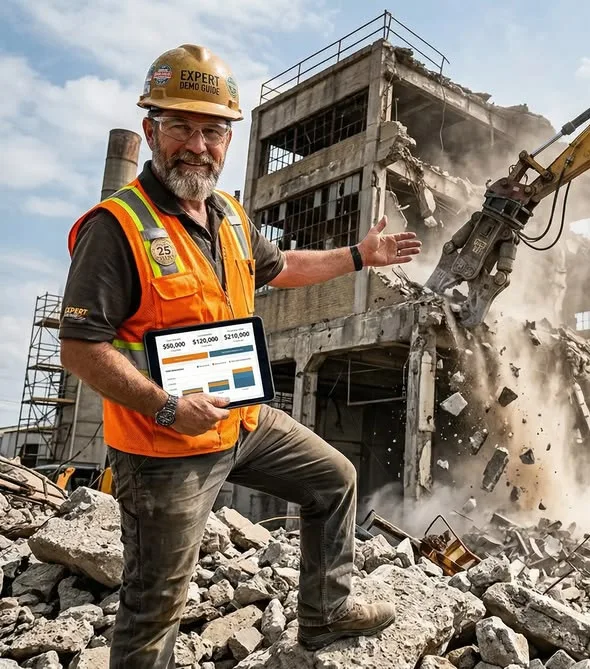
Most full demolition is mechanical. Excavators fitted with shears, grapples or hydraulic hammers pull the building down in a planned sequence, and high-reach machines handle taller structures. Explosive implosion exists, but it is rare and limited to large, specialized projects.
Full demolition usually includes:
- Hazardous material abatement before the structure comes down.
- Utility disconnects and capping.
- Removal of the superstructure, and the foundation if the scope says so.
- Sorting, hauling and recycling or disposal of all debris.
- Backfill and rough grading of the site, when included.
What Is Partial Demolition?
Partial demolition removes part of a building while the rest stays standing and often stays in use. Common examples are taking down a wing or an addition, removing upper floors, or keeping a historic facade while the building behind it is rebuilt.
The hard part of partial demolition is what stays. The remaining structure must be protected, and sometimes shored or braced, while the rest comes down. Cuts must be clean where old meets new, and the work is often slower and more manual near the line that separates the two.
Partial demolition usually adds:
- A structural review of how the remaining building will stand.
- Temporary shoring, bracing or facade support.
- Saw cutting at the separation line.
- Weather protection where walls or roofs are opened up.
- Phasing, dust and noise control if the rest of the building is occupied.
What Is Selective Demolition?
Selective demolition removes specific elements from a building and leaves the structure in place. It is also called interior demolition, strip-out or soft strip. Tenant improvements and renovations nearly always start with selective demolition.
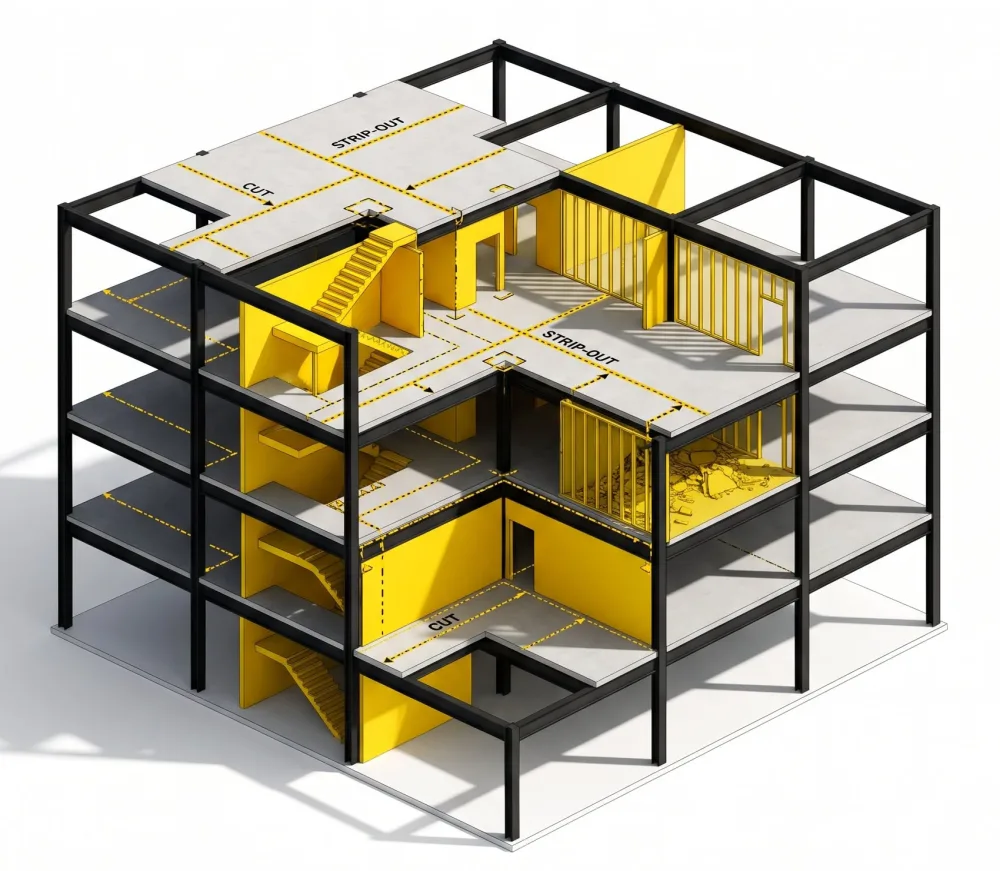
Typical selective demolition items include ceilings, partitions, flooring, doors, casework, fixtures and the mechanical, electrical and plumbing systems serving the space. It can also include saw cutting or core drilling slabs for new openings, trenches or shafts.
Some items are salvaged for reuse or recycling instead of being thrown away. In CSI MasterFormat, selective demolition sits under Division 02, Section 02 41 19, while general structure demolition falls under 02 41 16.
Full vs. Partial vs. Selective Demolition: Key Differences
Scope of Work
- Full: the whole structure, and often the foundation.
- Partial: a defined portion of the structure, with the rest protected.
- Selective: specific elements inside or on the building; the structure stays.
Equipment and Labor
Full demolition is equipment-heavy: excavators, attachments, loaders and trucks do most of the work. Selective demolition is labor-heavy: crews work by hand and with small tools, carts and mini machines inside the building. Partial demolition mixes both, with careful manual work near the structure that stays.
Debris Removal
Full demolition produces the most debris by far, mostly concrete, masonry, steel and wood. Selective demolition produces less but more mixed debris, such as ceiling tile, drywall, carpet and fixtures, and it often has to leave the building through tight paths and elevators. Partial demolition falls between the two.
Project Cost and Timeline
Full demolition moves fast once abatement and permits are done, because machines handle the volume. Selective and partial demolition can cost more per square foot than you might expect, because the work is slower, more manual and has to protect what stays. The type of demolition, not just the size of the building, drives the price. Our commercial demolition cost guide covers how contractors price each type per square foot.
How Do Contractors Estimate Demolition Costs?
Measuring Structural and Interior Elements
Start from the drawings and a site walk. For full demolition, measure the building footprint, the number of floors and the structural system. For selective demolition, measure each item to be removed in its own unit: ceilings and flooring by square foot, partitions by linear foot with their height, and doors, fixtures and equipment by each.
Calculating Concrete and Masonry Removal
Measure slabs, footings, walls and masonry by area and thickness, then convert them to cubic yards. Note the reinforcing, because heavily reinforced concrete takes longer to break and needs more hauling.
Normal-weight concrete weighs about 150 pounds per cubic foot, which is roughly 2 tons per cubic yard, so tonnage adds up fast. See our concrete demolition cost guide for slab and foundation removal.
Estimating Debris Volume and Disposal
Debris takes up more space once it is broken than it did in place, so convert in-place volume to loose volume before you count trucks or roll-off containers. Separate the debris by stream: concrete and masonry, metal, wood and mixed construction debris. Metal and clean concrete can often be recycled, which changes disposal cost compared with landfilling everything.
Accounting for Labor and Equipment
Price equipment by the day or week, including mobilization. Price labor from production rates for each task, adjusted for access, height and working around occupied areas. Then add the items that are easy to forget:
- Hazardous material survey and abatement.
- Permits and utility disconnects.
- Shoring, protection and temporary partitions.
- Dust control, water and street or sidewalk protection.
- Final cleanup and site restoration.
Common Demolition Estimating Mistakes
- Pricing the wrong type. A “demo” line that does not say full, partial or selective invites a scope fight later.
- Skipping the hazardous material survey. Under the EPA asbestos NESHAP rules, regulated buildings need an inspection before demolition or renovation, and abatement can change both cost and schedule.
- Underestimating debris weight. Concrete and masonry tonnage drives hauling and disposal.
- Forgetting protection on partial jobs. Shoring, weather protection and clean separation cuts are real costs.
- Ignoring access on selective jobs. Hauling debris through occupied corridors and small elevators slows crews down.
- No exclusions. State clearly what is not included, such as abatement, foundation removal or backfill.
Before bid day, run through our demolition bid checklist to catch these items.
When Should Contractors Hire a Demolition Estimator?
Outside help makes sense when the bid has a tight deadline, when the scope mixes partial and selective work, or when quantities need to be checked line by line before you commit to a number. Our demolition estimating services measure every item from your drawings and list assumptions and exclusions clearly, and our concrete and masonry takeoffs cover slab, foundation and masonry quantities.
For a quick look at budget numbers for a house teardown, see our demolition cost estimator. To see the format of a finished estimate, look at our demolition estimate sample, or read more about construction cost estimating at Design Estimation.
Share This Entry
Frequently Asked Questions
Quick answers for contractors and estimators.
What are the three main types of demolition?
Full demolition, partial demolition and selective demolition. Full removes the whole structure, partial removes part of it while the rest stays, and selective removes specific elements and leaves the structure in place.
Is selective demolition more expensive than full demolition?
Per square foot it often can be, because selective work is slower, more manual and has to protect what stays. The total price is usually lower because less material comes out.
What is included in a partial demolition estimate?
Removal of the defined portion, plus shoring or bracing, separation saw cuts, protection of the remaining building, debris hauling and any phasing requirements.
How do contractors calculate demolition debris?
They measure each material, convert it to cubic yards, apply a factor for the extra volume of broken material, and estimate tons for hauling and disposal by material type.
What equipment is used for commercial demolition?
Excavators with shears, grapples and hydraulic hammers, high-reach excavators for tall buildings, loaders, skid steers and dump trucks or roll-off containers. Selective work also uses small tools and compact machines.
How do contractors estimate concrete demolition costs?
By measuring slabs, footings and walls in cubic yards, noting reinforcing, converting to tons, and pricing breaking, loading, hauling and disposal or recycling.
What factors affect commercial demolition costs?
The type of demolition, building size and structure, hazardous materials, access and site conditions, debris weight and disposal options, permits and the schedule.
Related Articles
 Articles · 5 min readWhat Is a Subcontractor in Construction? Definition, Types, Contracts and How Subs BidRead Article →
 Articles · 1 min readComplete GC: Full Building Estimation SamplesRead Article →
 Articles · 8 min readTypes of Construction Drawings and Documents (Plus BOQ vs. BOM)Read Article →
 Articles · 10 min readTypes of Construction Cost Estimates: From Conceptual to DetailedRead Article →
 Articles · 11 min readDemolition Cost Estimator 2026-27: House Demo GuideRead Article →
 Articles · 10 min readTypes of Construction: Project Sectors and IBC Type I to V ExplainedRead Article →
Get a Bid-Ready Estimate in 24–48 Hours
Send your drawings and bid date. We'll confirm scope, price and delivery time before any work starts.