
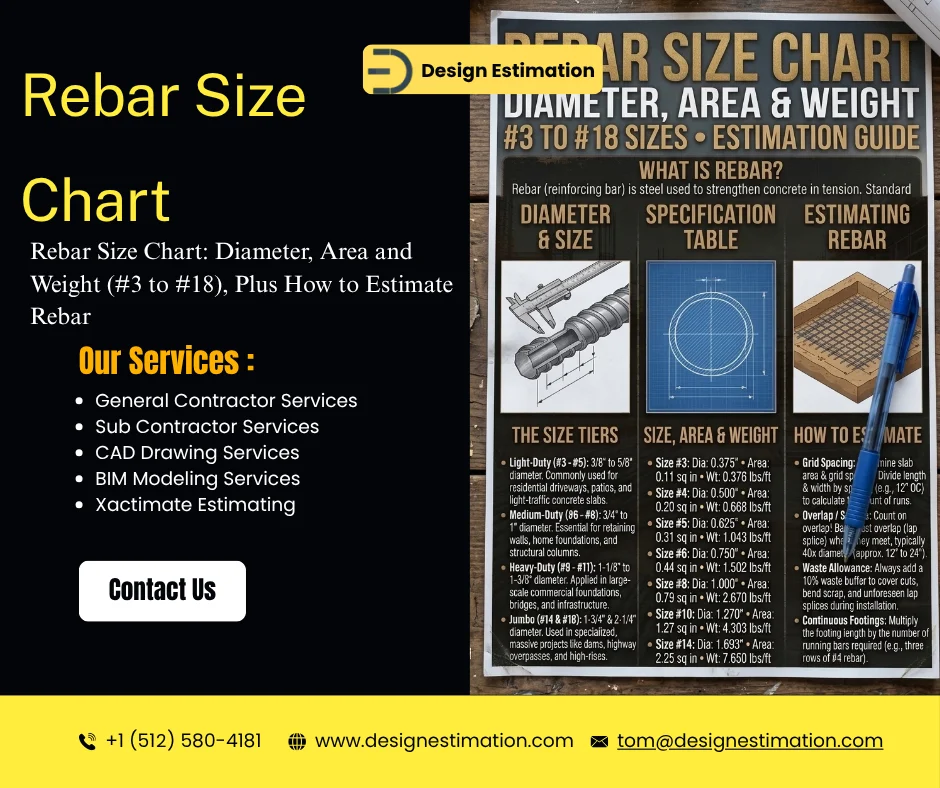
That rule covers most questions. The full chart below adds weight, area and metric equivalents for every standard size, and the second half of this guide shows how estimators turn a rebar schedule into pounds, tons and pieces to order.
Rebar Size Chart (ASTM A615)
| Bar size | Nominal diameter (in) | Diameter (fraction) | Area (sq in) | Weight (lb/ft) | Metric bar | Diameter (mm) |
|---|---|---|---|---|---|---|
| #3 | 0.375 | 3/8″ | 0.11 | 0.376 | #10 | 9.5 |
| #4 | 0.500 | 1/2″ | 0.20 | 0.668 | #13 | 12.7 |
| #5 | 0.625 | 5/8″ | 0.31 | 1.043 | #16 | 15.9 |
| #6 | 0.750 | 3/4″ | 0.44 | 1.502 | #19 | 19.1 |
| #7 | 0.875 | 7/8″ | 0.60 | 2.044 | #22 | 22.2 |
| #8 | 1.000 | 1″ | 0.79 | 2.670 | #25 | 25.4 |
| #9 | 1.128 | 1-1/8″ (approx.) | 1.00 | 3.400 | #29 | 28.7 |
| #10 | 1.270 | 1-1/4″ (approx.) | 1.27 | 4.303 | #32 | 32.3 |
| #11 | 1.410 | 1-3/8″ (approx.) | 1.56 | 5.313 | #36 | 35.8 |
| #14 | 1.693 | 1-3/4″ (approx.) | 2.25 | 7.650 | #43 | 43.0 |
| #18 | 2.257 | 2-1/4″ (approx.) | 4.00 | 13.600 | #57 | 57.3 |
Standard US inch-pound bar sizes per ASTM A615 / A706, with the matching soft-metric bar designations. Values as published by the Concrete Reinforcing Steel Institute (CRSI).
Sizes #9 and up no longer match the “eighths of an inch” rule exactly. Their diameters were set so each bar has a round-number area: #9 has 1.00 sq in, and #18 has 4.00 sq in. #12, #15, #16 and #17 are not produced as standard bars.
Most Common Rebar Sizes and Where They Are Used
| Bar size | Typical uses |
|---|---|
| #3 (3/8″) | Light slabs, sidewalks, patios, ties and stirrups, small footings |
| #4 (1/2″) | Residential footings and foundation walls, slabs on grade, driveways, CMU walls |
| #5 (5/8″) | Commercial slabs and footings, retaining walls, foundation walls with soil load |
| #6 to #8 | Beams, columns, structural slabs, mat foundations, heavier retaining walls |
| #9 to #11 | Columns and beams in mid- and high-rise buildings, bridges, heavy foundations |
| #14 and #18 | Large columns, bridge piers, heavy industrial and infrastructure work |
On residential and light commercial jobs, #4 and #5 bars make up most of the tonnage we take off. Heavier sizes appear mainly in commercial frames, mat foundations and infrastructure.
Rebar Diameters Explained: #3, #4, #5 and #6
These four sizes generate most of the questions, so here they are side by side:
| Bar | Diameter | Metric equivalent | Area | Weight | Weight of a 20 ft bar |
|---|---|---|---|---|---|
| #3 | 3/8″ | #10 (9.5 mm) | 0.11 sq in | 0.376 lb/ft | 7.5 lb |
| #4 | 1/2″ | #13 (12.7 mm) | 0.20 sq in | 0.668 lb/ft | 13.4 lb |
| #5 | 5/8″ | #16 (15.9 mm) | 0.31 sq in | 1.043 lb/ft | 20.9 lb |
| #6 | 3/4″ | #19 (19.1 mm) | 0.44 sq in | 1.502 lb/ft | 30.0 lb |
Metric Rebar Sizes
US mills label bars with either inch-pound numbers or “soft metric” numbers. The steel is identical; only the stamp changes. A #13 metric bar is the same as a #4, a #16 is a #5, and a #19 is a #6. The metric number is the diameter rounded to the nearest millimeter. Projects outside the US often use different metric series (10M, 15M, 20M in Canada, or 10, 12, 16 mm bars elsewhere), so always check which system the drawings use.
Rebar Grades and Markings
Size tells you how big a bar is. Grade tells you how strong it is, as its minimum yield strength in thousands of psi:
- Grade 40 (40,000 psi): lighter residential and non-structural work.
- Grade 60 (60,000 psi): the standard for most building construction.
- Grade 80 and higher: heavily loaded columns and high-rise work, where it reduces congestion.
Each bar is rolled with markings in this order: the producing mill, the bar size, the steel type (S for ASTM A615, W for weldable A706) and a grade mark (for Grade 60, either the number 60 or one continuous longitudinal line). Inspectors check these marks against the specs, so the size you order must match what the drawings call for.
Standard Rebar Lengths
Most suppliers stock straight bars in 20 ft, 40 ft and 60 ft lengths. Home centers usually carry 10 ft and 20 ft #3, #4 and #5. Longer bars mean fewer laps but are harder to ship and handle, so commercial projects usually order bars cut and bent to a schedule rather than stock lengths.
How to Estimate Rebar Quantities
Rebar is bought by weight and installed by the piece, so an estimate needs both. This is the sequence our estimators follow:
- Read the reinforcing schedule and general notes. Note bar sizes, spacing, cover, lap splice lengths and hook requirements for each element.
- Count bars from spacing. Number of bars = (length to cover / spacing) + 1, for each direction and each layer.
- Find each bar’s length. Element length minus cover at both ends, plus hooks and bends.
- Add lap splices. Wherever a run is longer than the stock length, add one lap per splice. Use the splice length on the drawings; a common rule of thumb is 40 to 48 bar diameters, but the engineer’s number governs.
- Total the linear feet by bar size.
- Convert to weight. Linear feet x weight per foot from the chart. Divide by 2,000 for tons.
- Add waste and accessories. Allow about 5% for cut-off and waste on straight stock, and take off chairs, bolsters and tie wire separately.
A quick check for weight per foot: weight (lb/ft) = 2.67 x diameter squared (in). Our guide to concrete reinforcement weight calculation goes deeper on the weight math and lap splices.
Worked Example: Rebar for a 40 ft x 30 ft Slab
A 40 ft x 30 ft slab on grade with #4 bars at 12″ on center each way, using 20 ft stock bars and a 24″ lap (48 bar diameters). Cover is ignored here to keep the math clear.
| Line item | Calculation | Quantity |
|---|---|---|
| Bars running 40 ft | (30 ft / 1 ft) + 1 | 31 bars |
| Bars running 30 ft | (40 ft / 1 ft) + 1 | 41 bars |
| Linear feet, 40 ft bars | 31 x 40 ft | 1,240 lf |
| Linear feet, 30 ft bars | 41 x 30 ft | 1,230 lf |
| Lap splices | 1 lap per run x 2 ft | 144 lf |
| Total #4 rebar | Sum of the above | 2,614 lf |
| Weight | x 0.668 lb/ft | 1,746 lb |
| Weight with 5% waste | x 1.05 | 1,833 lb (about 0.92 tons) |
| 20 ft bars to order | Total lf x 1.05 / 20 | 138 bars |
Two things change this number on a real job: cover, which shortens every bar by a few inches, and edge or thickened-slab bars, which add to it. A slab plan that calls for bars “each way, top and bottom” doubles the whole takeoff.
Fiberglass (GFRP) Rebar vs. Steel Rebar
Glass fiber reinforced polymer (GFRP) rebar is sold in the same nominal sizes as steel and is now covered by its own ACI design code (ACI 440.11). It is worth knowing how it differs before you price it:
| Property | Steel rebar | Fiberglass (GFRP) rebar |
|---|---|---|
| Weight | Baseline | About one-quarter the weight of steel |
| Corrosion | Rusts without coating or cover | Does not corrode |
| Tensile strength | Grade 60 yields at 60,000 psi | Higher tensile strength, but no yield point |
| Stiffness | High | Much lower, so designs need more bars or larger sizes |
| Field bending | Can be bent on site | Cannot be bent on site; bends must be made at the factory |
| Typical uses | All structural concrete | Marine work, bridge decks, parking structures, MRI rooms |
GFRP is not a one-for-one swap. Because it is less stiff, an engineer has to design for it, and a #4 GFRP bar is not equivalent to a #4 steel bar. Price it only when the drawings call for it.
Need a Rebar Takeoff or Bar Bending Schedule?
Design Estimation prepares rebar takeoffs and bar lists for general contractors, concrete subcontractors and fabricators across the US, with tonnage by bar size and element, lap and hook allowances, and accessories. Turnaround is typically 24 to 48 hours. See our rebar estimating services, or send your structural drawings for a quote.
Share This Entry
Frequently Asked Questions
Quick answers to the questions contractors ask us most.
What is the diameter of #4 rebar?
#4 rebar is 1/2″ (0.500 in) in diameter, or 12.7 mm. It has a cross-sectional area of 0.20 sq in and weighs 0.668 lb per foot. Its metric designation is #13.
What is the diameter of #5 rebar?
#5 rebar is 5/8″ (0.625 in) in diameter, or 15.9 mm. It has an area of 0.31 sq in, weighs 1.043 lb per foot and is labeled #16 in metric.
What size is #6 rebar?
#6 rebar is 3/4″ (0.750 in) in diameter, or 19.1 mm. It has an area of 0.44 sq in and weighs 1.502 lb per foot. The metric equivalent is #19.
How do rebar sizes work?
For #3 through #8, the bar number is the diameter in eighths of an inch. A #3 is 3/8″, a #8 is 8/8″ or 1″. Larger bars are sized to round-number areas instead.
What lengths does rebar come in?
Suppliers usually stock 20 ft, 40 ft and 60 ft bars. Home centers often sell 10 ft and 20 ft lengths. Commercial jobs typically order bars cut and bent to a schedule.
What size rebar is used for a concrete slab?
Most residential slabs and driveways use #3 or #4 bars at 12″ to 18″ on center each way. Commercial and heavily loaded slabs often use #4 or #5. The structural drawings set the actual size and spacing.
Can fiberglass rebar be bent on site?
No. Fiberglass (GFRP) rebar cannot be field bent. Hooks, stirrups and bends must be manufactured at the factory, so bent shapes have to be ordered from a schedule in advance.
Related Articles
 Articles · 13 min readCMU Block Sizes & Dimensions: Chart, Blocks per Sq Ft, and How to EstimateRead Article →
 Articles · 7 min readBrick Sizes and Dimensions Chart (US, UK, Australia) + Bricks per Square FootRead Article →
 Articles · 10 min readRebar in Footings, Slabs and Stirrups: Spacing, Layout and Bar Bending SchedulesRead Article →
 Articles · 10 min readConcrete Reinforcement Weight Calculation: Pro GuideRead Article →
 Articles · 9 min readHow Accurate Estimates Protect Your Profit MarginRead Article →
 Articles · 7 min readCut and Fill Calculation: How to Estimate Earthwork VolumesRead Article →
Get a Bid-Ready Estimate in 24–48 Hours
Send your drawings and bid date. We'll confirm scope, price and delivery time before any work starts.