
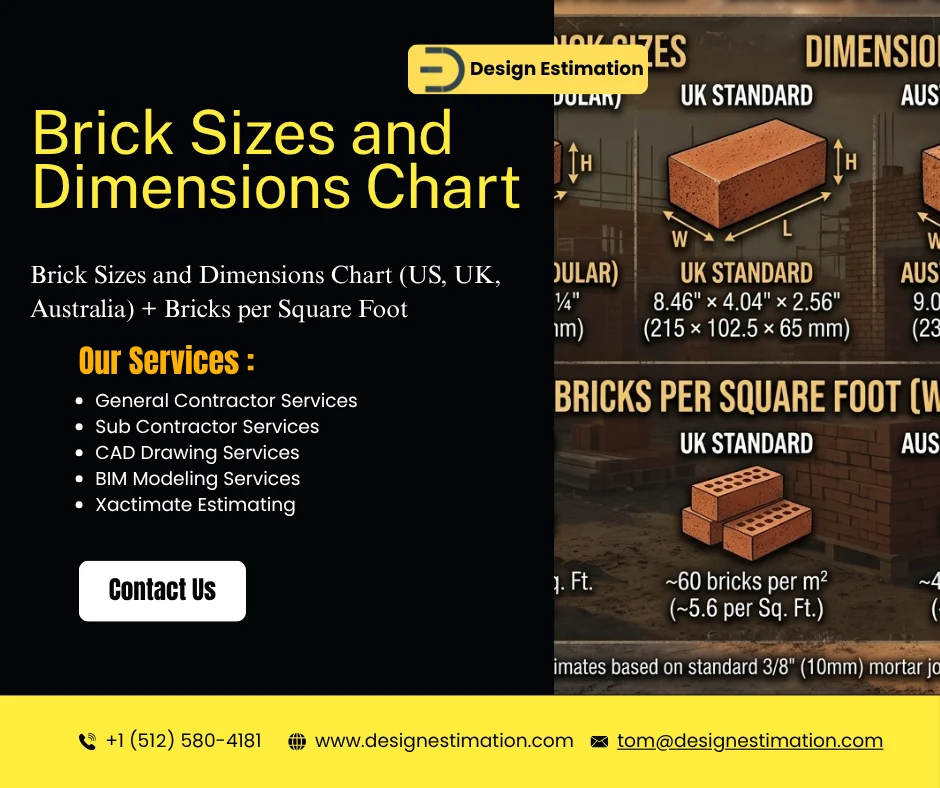
“Standard brick size” means different things in different places, and even in the US there are a dozen common sizes. Below is the full chart, how nominal and actual sizes relate, and how to work out how many bricks a wall needs.
Brick Sizes Chart (US)
| Brick type | Actual size (W x H x L) | Nominal size (W x H x L) | Bricks per sq ft |
|---|---|---|---|
| Modular | 3-5/8″ x 2-1/4″ x 7-5/8″ | 4″ x 2-2/3″ x 8″ | 6.75 |
| Standard (non-modular) | 3-5/8″ x 2-1/4″ x 8″ | Not on the 4″ module | about 6.55 |
| Engineer modular | 3-5/8″ x 2-13/16″ x 7-5/8″ | 4″ x 3-1/5″ x 8″ | 5.63 |
| Closure modular | 3-5/8″ x 3-5/8″ x 7-5/8″ | 4″ x 4″ x 8″ | 4.50 |
| Roman | 3-5/8″ x 1-5/8″ x 11-5/8″ | 4″ x 2″ x 12″ | 6.00 |
| Norman | 3-5/8″ x 2-1/4″ x 11-5/8″ | 4″ x 2-2/3″ x 12″ | 4.50 |
| Utility | 3-5/8″ x 3-5/8″ x 11-5/8″ | 4″ x 4″ x 12″ | 3.00 |
| Queen | about 3″ x 2-3/4″ x 7-5/8″ | Non-modular | about 5.76 |
| King | about 3″ x 2-5/8″ x 9-5/8″ | Non-modular | about 4.80 |
Common US sizes as described by the Brick Industry Association (BIA). Bricks per sq ft assume 3/8″ mortar joints and running bond. Manufacturer dimensions vary slightly, especially for queen and king sizes.
Modular brick is the default in most US commercial and residential work. Queen and king sizes are popular on houses in the South and Southwest because their thinner width and larger face cover a wall with fewer units. Utility and Norman bricks lay up faster on large walls because each unit covers more area.
Nominal vs. Actual Brick Dimensions
Actual size is the brick itself. Nominal size is the brick plus one mortar joint. Modular bricks are made 3/8″ short in each direction so that, with a 3/8″ joint, they land on a 4″ grid that lines up with CMU, windows and door openings.
- Length: 7-5/8″ brick + 3/8″ joint = 8″ nominal, so two bricks equal one 16″ CMU.
- Height: 2-1/4″ brick + 3/8″ joint = 2-5/8″; three courses come to 8″ at a slightly adjusted joint, so three brick courses match one 8″ CMU course.
- Width: 3-5/8″ actual, 4″ nominal, which is the standard veneer thickness.
That 3:1 coursing match is why modular brick pairs so easily with block backup walls. Our CMU block sizes guide covers the block side of that module.
Standard Brick Sizes Outside the US
| Country | Standard brick (L x W x H) | With mortar joint | Bricks per square meter |
|---|---|---|---|
| United Kingdom | 215 x 102.5 x 65 mm | 225 x 112.5 x 75 mm (10 mm joint) | about 60 |
| Australia | 230 x 110 x 76 mm | 240 x 120 x 86 mm (10 mm joint) | about 48.5 |
| Canada | Uses US-style modular and metric modular sizes | Varies by maker | Varies |
UK size per BS EN 771-1 standard format. Always confirm with the manufacturer.
How Many Bricks per Square Foot?
Divide 144 sq in by the nominal face area of one brick (nominal length x nominal height). For a modular brick: 8″ x 2-2/3″ = 21.33 sq in, and 144 / 21.33 = 6.75 bricks per square foot. The same method works for any size in the chart.
That figure is for a single wythe (one brick thick) in running bond. A double-wythe wall needs twice as many. Patterns that turn bricks to show their ends or ends and sides, such as Flemish or English bond, also change the count.
How to Estimate Bricks for a Wall
- Measure each wall and multiply length by height for gross area.
- Deduct openings for windows and doors.
- Multiply net area by bricks per square foot for your brick size.
- Add waste: about 5% for plain walls, more for walls with lots of corners, cuts or soldier courses.
- Take off mortar: roughly 8 cubic feet of mortar per 1,000 modular bricks with 3/8″ joints, before waste.
- Count accessories: wall ties, flashing, weeps, lintels and expansion joints.
Worked Example: Brick Veneer Wall
A 40 ft x 8 ft brick veneer wall in modular brick, with two 3 ft x 4 ft windows:
| Line item | Calculation | Quantity |
|---|---|---|
| Gross area | 40 ft x 8 ft | 320 sq ft |
| Openings | 2 x 3 ft x 4 ft | 24 sq ft |
| Net area | 320 – 24 | 296 sq ft |
| Bricks | 296 x 6.75 | 1,998 bricks |
| Bricks to order | x 1.05 (5% waste) | about 2,100 bricks |
| Mortar | about 8 cu ft per 1,000 bricks | about 17 cu ft |
| Wall ties | 1 tie per 2.67 sq ft | about 111 ties |
The tie count follows the common residential rule for brick veneer over wood framing: one tie for every 2.67 sq ft of wall, which works out to ties at 16″ on center horizontally and about 24″ vertically. Check the drawings and local code for your project.
Brick Types You Will See on Drawings
- Face brick: made for appearance and weather exposure, used on exterior walls.
- Common (building) brick: lower-grade units for backup walls and areas that will not be seen.
- Thin brick: about 1/2″ to 1″ thick, applied like tile over a backing. It is priced by the square foot, not as full brick.
- Fire brick: dense refractory brick for fireplaces, chimneys and kilns, laid with refractory mortar.
- Paving brick: solid units rated for foot or vehicle traffic, often 4″ x 8″ for patios and walks.
Prices vary widely by type, color and region. Our brick cost estimator guide covers pricing per brick and per square foot.
Need a Masonry Takeoff?
Design Estimation prepares brick and masonry takeoffs for general contractors and masonry subcontractors across the US, with brick counts by size and wall type, mortar, ties, flashing, lintels and accessories. Turnaround is typically 24 to 48 hours. See our concrete and masonry takeoff services or send your drawings for a quote.
Share This Entry
Frequently Asked Questions
Quick answers to the questions contractors ask us most.
What is the standard size of a brick in the US?
The standard US modular brick is 3-5/8″ x 2-1/4″ x 7-5/8″. With a 3/8″ mortar joint, its nominal size is 4″ x 2-2/3″ x 8″.
How many bricks are in a square foot?
About 6.75 modular bricks per square foot of wall, with 3/8″ joints. Larger sizes need fewer: Norman bricks take about 4.5 and utility bricks about 3 per square foot.
How long is a brick?
A modular brick is 7-5/8″ long, or 8″ with the mortar joint. Norman, Roman and utility bricks are 11-5/8″ long, or 12″ nominal.
How wide is a brick?
Most US bricks are 3-5/8″ wide, which is 4″ nominal with the joint. Queen and king sizes are narrower, at about 3″ wide.
What is the size of a brick in the UK?
A standard UK brick is 215 x 102.5 x 65 mm. With 10 mm mortar joints, about 60 bricks cover one square meter of single-skin wall.
What is a Norman brick?
A Norman brick is 3-5/8″ x 2-1/4″ x 11-5/8″, a longer version of the modular brick. It has the same height, so it courses like modular brick but needs fewer units per square foot.
What is the difference between nominal and actual brick size?
Actual size is the brick itself; nominal size includes one mortar joint. Modular bricks are made 3/8″ smaller so the nominal size fits a 4″ building module.
Related Articles
 Articles · 13 min readCMU Block Sizes & Dimensions: Chart, Blocks per Sq Ft, and How to EstimateRead Article →
 Articles · 10 min readCost per Square Foot to Build a House: 2026-27 Numbers and BreakdownRead Article →
 Articles · 8 min readRebar Size Chart: Diameter, Area and Weight (#3 to #18), Plus How to Estimate RebarRead Article →
 Articles · 12 min readBrick Cost Estimator 2026-27: Brick Wall & Patio Cost Calculator USARead Article →
 Articles · 13 min readMasonry Repair Cost: Guide to Brick and Stone PricingRead Article →
 Articles · 2 min readMasonry Takeoff Services in the USA: Brick, Block and StoneRead Article →
Get a Bid-Ready Estimate in 24–48 Hours
Send your drawings and bid date. We'll confirm scope, price and delivery time before any work starts.