
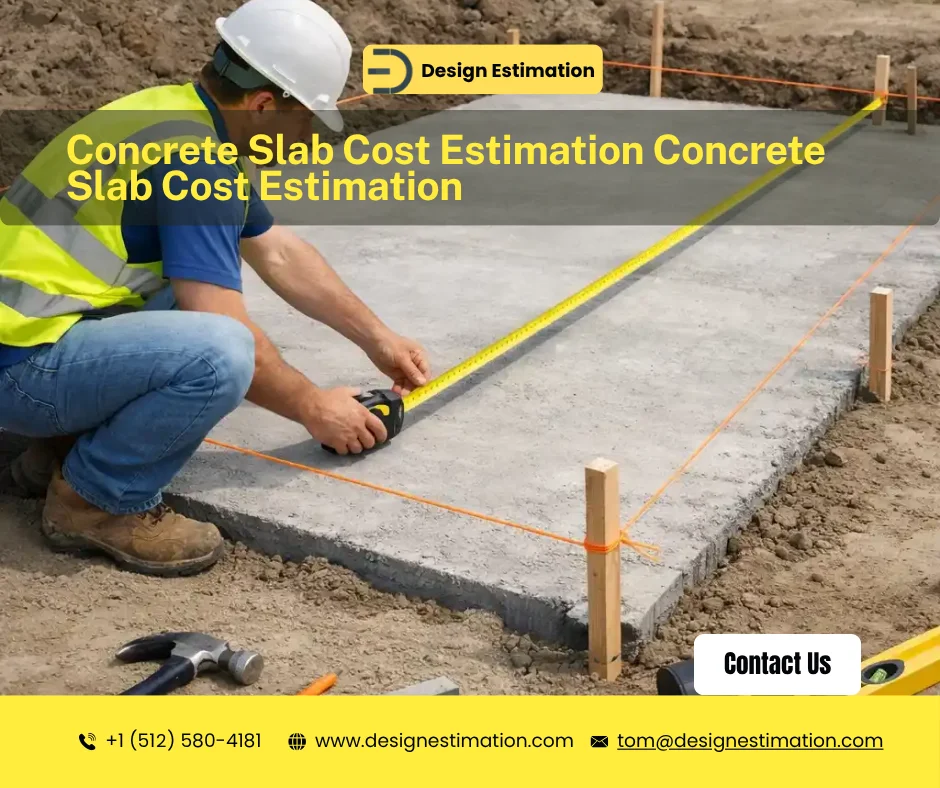
Slabs look simple, but most of their cost sits outside the concrete truck. This guide shows how to calculate a slab estimate and what changes the number.
Step-by-Step Slab Calculation
- Volume: length × width × thickness (in feet) ÷ 27 = cubic yards.
- Thickened edges and interior footings: add their volume separately.
- Waste: add a small percentage for over-excavation and spillage.
- Base: area × base depth for gravel or crushed stone.
- Vapor barrier: slab area plus laps.
- Reinforcing: rebar by spacing and size, or welded wire by area. See our rebar size chart.
- Forming: perimeter in linear feet.
- Labor: placing, finishing, joints and curing.
- Pump: if the truck cannot reach.
Worked Example: 30 × 30 Slab, 4 Inches Thick (Illustrative)
- Area: 900 square feet.
- Volume: 900 × 0.333 ÷ 27 ≈ 11.1 cubic yards, plus waste ≈ 11.7 cubic yards.
- Perimeter forms: 120 linear feet.
- Base at 4 inches: 900 × 0.333 ÷ 27 ≈ 11.1 cubic yards of stone.
- Vapor barrier: about 900 square feet plus laps.
- Reinforcing: per the drawings, for example #3 or #4 bars at a set spacing each way, or welded wire.
Apply your local ready-mix, material and labor prices to these quantities to get the cost.
Fill in your details and we’ll get back to you with a quote.
- Quote reply within 1 hour
- Estimates in 24–48 hours
- Prepared by human estimators
What Changes Slab Cost
- Soils: expansive clay may require moisture conditioning, select fill, void forms or a structural slab.
- Engineering: post-tensioned slabs add tendons, anchors and stressing.
- Finish: polished, stamped or colored finishes add materials and labor.
- Access: pump trucks for tight sites.
- Weather: hot or cold weather protection.
Our foundation cost estimating guide covers soils and foundation types.
Why a Takeoff Beats a Rough Rate
A flat cost per square foot ignores thickened edges, reinforcing, soil requirements and site access. A takeoff from the drawings captures each of them, which is what makes the bid accurate.
What You Receive
- Concrete, base, reinforcing and forming quantities.
- Labor and equipment.
- Marked-up foundation plans.
See our concrete cost estimating guide and concrete and masonry takeoff services, or send your plans.
Share This Entry
Standards referenced: ACI 302.1R (concrete floor and slab construction) and ACI 318. Always check the edition adopted for your project.
Frequently Asked Questions
Quick answers to the questions contractors ask us most.
How do you calculate concrete for a slab?
Multiply length by width by thickness in feet, divide by 27 for cubic yards, then add thickened edges and waste.
How many cubic yards are in a 30×30 slab 4 inches thick?
About 11.1 cubic yards before waste, or roughly 11.7 cubic yards with a small waste allowance.
Does a slab need rebar or mesh?
It depends on the design; the structural drawings specify rebar, welded wire or fibers.
Why do slabs cost more on expansive soils?
They may need moisture conditioning, select fill, void forms or structural slabs to prevent movement.
How long does a slab takeoff take?
Most slab takeoffs are delivered in 24 to 48 hours.
Are concrete estimates prepared by AI or human estimators?
Our estimates are prepared and reviewed by experienced human estimators, with software used to speed up measuring.
Related Articles
 Articles · 6 min readMeet the New Design Estimation Calculators: Free Concrete and Lumber Weight ToolsRead Article →
 Articles · 3 min readHome Construction Estimating Tools: Cost Books, Software and Free EstimatorsRead Article →
 Articles · 6 min read5D BIM for Cost Estimation: How It Works and Where It Falls ShortRead Article →
 Articles · 4 min readLandscape Cost Estimating: How to Estimate Landscaping JobsRead Article →
 Articles · 8 min readWhat Should a Construction Estimating Service Actually Cost?Read Article →
 Articles · 7 min readAsphalt Paving Cost Calculator: Contractor Paving Guide (2026-27)Read Article →
Get a Bid-Ready Estimate in 24–48 Hours
Send your drawings and bid date. We'll confirm scope, price and delivery time before any work starts.