
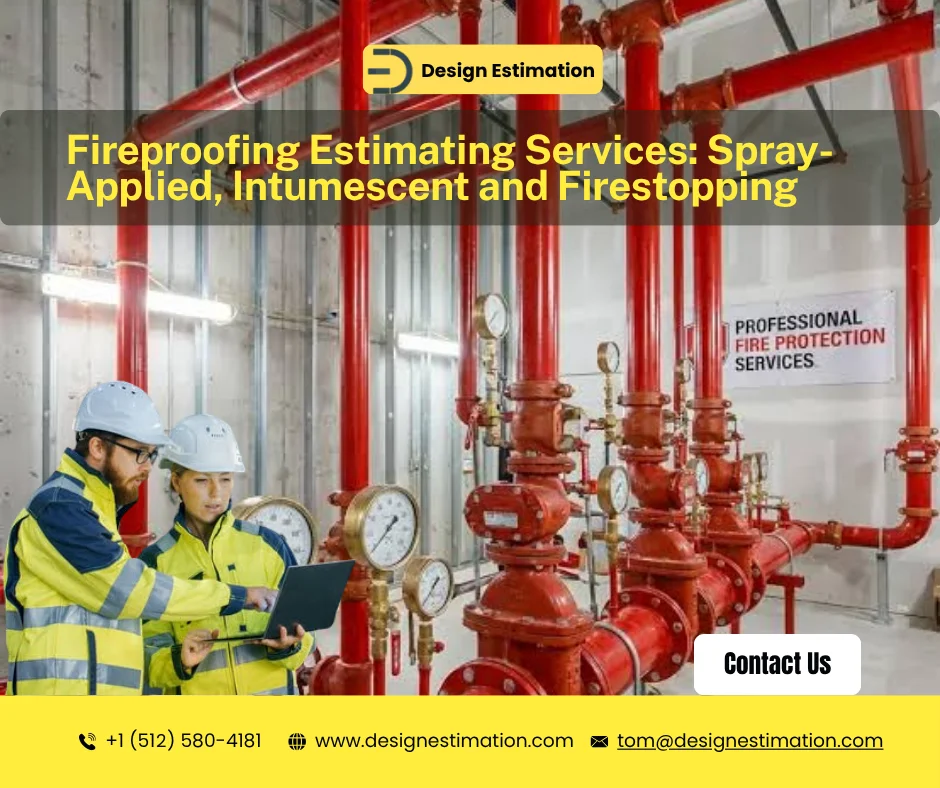
Fireproofing is driven by code requirements, not just quantities. The same beam may need different thicknesses depending on its rating and listed design. This guide explains how fireproofing and firestopping are estimated.
What a Fireproofing Estimate Includes
| Item | How it is measured |
|---|---|
| SFRM on beams and columns | Surface area or weight by member, with thickness from the listed design |
| SFRM on deck | Square feet by thickness |
| Intumescent coatings | Surface area by member and required dry film thickness |
| Firestopping at penetrations | Each, by penetration type and wall or floor rating |
| Joint firestopping | Linear feet at head-of-wall and floor edges |
| Access and protection | Lifts, masking and overspray protection |
| Inspection | Thickness and density testing as specified |
Fill in your details and we’ll get back to you with a quote.
- Quote reply within 1 hour
- Estimates in 24–48 hours
- Prepared by human estimators
Where Requirements Come From
The code analysis and life safety plans define construction type and ratings for structural members, walls and floors. Specifications list the products and tested designs. The estimate applies the thickness required by each listed design to each member type. Our guide to types of construction (IBC Type I to V) explains how construction type sets ratings.
SFRM vs. Intumescent
Spray-applied materials are usually less expensive and used where steel is hidden. Intumescent coatings are thinner and look like paint, so they are used on exposed architectural steel, but they cost more and need more coats. The choice affects both material and labor.
Firestopping
Every pipe, duct, conduit or cable that passes through a rated wall or floor needs a tested firestop system. On MEP-heavy buildings the number of penetrations can be large, so firestopping should be counted from MEP and architectural drawings, not allowed as a small lump sum.
What You Receive
- Fireproofing quantities by member type and rating.
- Firestopping counts and joint lengths.
- Labor, access and inspection allowances.
- Marked-up drawings.
See our Division 07 estimating guide and structural steel estimating guide, or send your plans.
Share This Entry
Frequently Asked Questions
Quick answers to the questions contractors ask us most.
What is SFRM?
SFRM is spray-applied fire-resistive material, a cementitious or fiber-based coating applied to structural steel to achieve a fire rating.
How is fireproofing thickness determined?
By the required fire rating and the listed design for each member, as specified in the drawings and specifications.
Is intumescent paint more expensive than spray fireproofing?
Usually, yes. Intumescent coatings cost more but are thinner and suited to exposed steel.
Do you include firestopping in the estimate?
Yes. Firestopping is counted by penetration and joint length when it is in scope.
How long does a fireproofing takeoff take?
Most fireproofing takeoffs are delivered in 24 to 48 hours.
Are fireproofing estimates prepared by AI or human estimators?
Our estimates are prepared and reviewed by experienced human estimators, with software used to speed up measuring.
Related Articles
 Articles · 2 min readInsulation Estimating Services: Batt, Spray Foam, Rigid and Blown-InRead Article →
 Articles · 3 min readIndustrial Estimating Services: Plants, Warehouses and Process FacilitiesRead Article →
 Articles · 4 min readPreliminary Estimating Services: Budgets From Early DrawingsRead Article →
 Articles · 8 min readIn-House vs. Outsourced Estimating: A Cost-Benefit Analysis for Small ContractorsRead Article →
 Articles · 7 min readGovernment & Public Works Bidding: How to Win Without LosingRead Article →
 Articles · 11 min readRenovation Estimating Services 2026-27: Accurate Pricing GuideRead Article →
Get a Bid-Ready Estimate in 24–48 Hours
Send your drawings and bid date. We'll confirm scope, price and delivery time before any work starts.