
I am Austin Smith, the founder of Design Estimation LLC. Over the last 25 years, I have worked in civil engineering and construction estimating. Let me shoot straight with you. The exterior siding market in 2026-27 is completely unforgiving. Material prices jump around every single month. Finding skilled labor feels like a full-time job. Because of this, you simply cannot guess your numbers anymore.
I see contractors eyeball a house, guess the square footage, and throw out a random bid. Often, they win the job only to realize they ordered too little material, and bleed money trying to fix it. When you underbid a job, you pay for the extra materials out of your own pocket. You absolutely need a highly accurate Siding Cost Estimator to survive right now.
Why professional estimation matters
A real Siding Cost Estimator stops you from bidding blind. By using one, you can calculate the exact wall area while accounting for trim, waste factors, and specific local labor rates. Our team decided to publish the raw numbers we are seeing out in the field. We are going to break down exactly what drives exterior cladding costs this year. Whether you crunch the numbers yourself or hire professional estimators, you need hard facts. Let’s look at what it actually takes to price an exterior job profitably today. To ensure your project stays within budget from top to bottom, our siding analysis is integrated with our comprehensive Exterior Finishes Estimating Services for contractors.
Why blind bidding destroys your profit margins
To stay in business, you have to stop guessing. Construction profit margins are incredibly tight. Most general contractors only clear a 5% to 8% net profit margin on a good day. When your material takeoff is wrong by just 10%, your entire profit for the week is wiped out. A reliable Siding Cost Estimator protects that delicate margin. The system breaks down raw materials, shipping costs, equipment rentals, and labor hours. A good estimate also builds in a safety net for hidden damages. When you rip off old siding, you almost always find rotted wood or water damage underneath. Failing to budget for those repairs means you eat the loss
How to estimate siding cost accurately
If you want to know how to estimate siding cost without making mistakes, start with a good tape measure. You have to calculate the total exterior square footage first. Measure the height and width of every rectangular wall on the house. Multiply those two numbers together to get your total surface area for that wall. Do the exact same thing for the triangular gable ends up near the roof. But remember to divide that final number in half, because it is a triangle.
Add all those wall areas together. Next, you have to measure your doors and windows. Subtract that open square footage from your total wall area. Since you do not put siding over windows, you shouldn’t charge the client for that material. Once you have the exact net square footage, you can finally start pricing materials.
The 10% waste factor rule
Here is where most new guys mess up. They calculate the exact square footage and order exactly that much material. Doing this is a massive mistake. You must always add a waste factor to your estimate cost of siding. When you cut siding panels to fit around windows or rooflines, you generate scrap.
Keep in mind that you cannot use those weirdly shaped off-cuts anywhere else. Standard industry practice is to add 10% to your total square footage to cover this waste. If the house has a ton of custom windows, dormers, or complex angles, bump that waste factor up to 15%. Running out of material mid-job costs you time and money.
Vinyl siding cost estimator and material breakdown
Vinyl is still the undisputed king of the residential market. It currently holds about 38% to 41% of the total U.S. siding market share. This material is extremely budget-friendly and fast for crews to install. A high-quality vinyl siding cost estimator will show you exactly why it remains so popular.
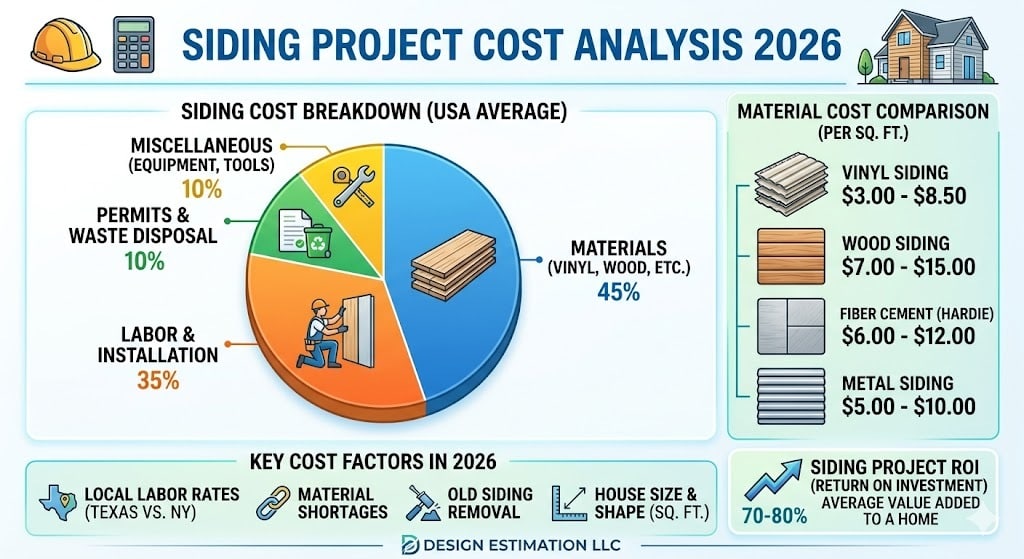
In 2026-27, the average installed cost for standard vinyl siding runs between $4.50 and $8.20 per square foot. If you upgrade to insulated vinyl, that price jumps up. While insulated vinyl costs more upfront, it adds an extra layer of energy efficiency to the home. This helps homeowners reduce their heating and cooling costs over time.
2026-27 Material Price Table
Here is a realistic look at installed costs for popular siding materials this year.
| Siding Material | Estimated 2026-27 Installed Cost (Per Sq. Ft.) | Durability & Maintenance |
| Standard Vinyl | $4.50 – $8.20 | Low maintenance, budget-friendly |
| Insulated Vinyl | $6.00 – $10.00 | Better impact resistance, lowers energy bills |
| Engineered Wood | $7.00 – $12.00 | Classic look, needs careful installation |
| Fiber Cement | $6.00 – $15.00 | Highly durable, fire-resistant |
| Stucco | $9.30 – $16.90 | Great insulation, prone to cracking in wet climates |
Vinyl siding vs Hardie Board cost 2026-27
I get asked about this comparison every single week. Homeowners constantly debate between standard vinyl and James Hardie fiber cement products. Vinyl is significantly more affordable. The material is light, easy to cut, and goes up fast. A vinyl siding cost estimator usually tops out around $8.20 per square foot installed.
Hardie Board (fiber cement) is a completely different animal. It is incredibly heavy and requires specialized saw blades to cut through the cement mixture. Because it is heavy and creates toxic silica dust when cut, labor costs are much higher. Hardie Board installation usually costs between $4.70 and $15.00 per square foot. However, fiber cement lasts 50 to 100 years and is highly resistant to fire and pests. Vinyl usually only lasts 20 to 40 years before it gets brittle and needs replacing.
How to estimate siding cost for premium materials
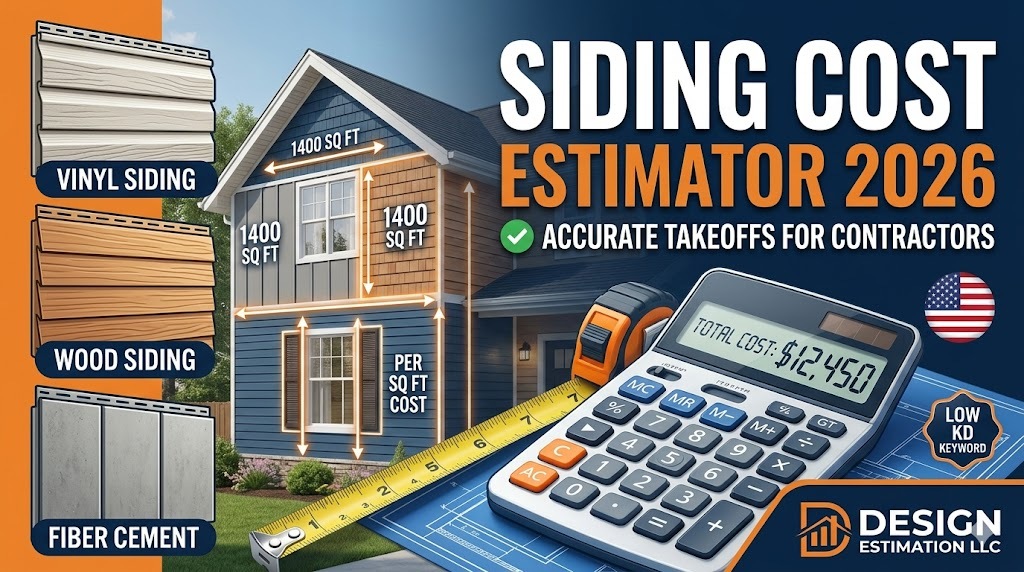
If your client wants a massive visual upgrade, you need to know how to estimate siding cost for premium, heavy materials. Real natural stone veneer is the most expensive option on the market today. The materials alone are incredibly pricey, and the labor required to set the stones is intense.
Expect to pay anywhere from $30 to $48 per square foot for fully installed natural stone siding. Brick veneer is another heavy option, usually running $8 to $13 per square foot. Real cedar wood siding gives a classic, beautiful look but requires intense maintenance. Depending on the lumber quality, real wood costs anywhere from $6.90 to $13.90 per square foot. If you bid a stone or brick job using vinyl labor rates, you will bankrupt your company. You have to account for the heavy lifting and slower installation pace.
Siding replacement cost estimator checklist for contractors
A reliable siding replacement cost estimator looks at the whole house, not just the main wall panels. Missing the required accessories is the fastest way to kill your profit. Your material takeoff absolutely must include the house wrap or weather barrier. Make sure to count the linear feet of J-channel as well, which hides the cut edges around windows. Additionally, you must measure and order the outside corner posts, inside corner posts, and starter strips for the bottom row.
Don’t forget the details
Do not forget to calculate the soffit panels under the eaves and the aluminum fascia boards wrapped around the roofline. Lastly, count your tubes of exterior color-matched caulk. If you forget to bill the client for all these accessory pieces, you end up buying them out of your own pocket.
Real-World Case Study: Commercial Siding Project in Dallas
I want to share a real project we recently estimated at Design Estimation LLC to show you how these numbers play out in the real world. We handled the takeoff for a 10,000 square foot commercial retail space up in Dallas, Texas. The architect specified a mix of stucco and premium stone veneer.
Dallas is a highly competitive market, and commercial construction costs there average between $190 and $340 per square foot for the total build. We had to get the exterior cladding numbers perfect. The front facade required 2,500 square feet of natural stone veneer. At $35 per square foot installed, that portion alone budgeted out to $87,500. The remaining 7,500 square feet of the building was specified for commercial stucco. We priced the stucco installation at $14 per square foot, totaling $105,000.
| Dallas Retail Project (10,000 sq ft) | Material & Labor Breakdown | Estimated Cost |
| Natural Stone Veneer | 2,500 sq ft @ $35.00/sf | $87,500 |
| Commercial Stucco | 7,500 sq ft @ $14.00/sf | $105,000 |
| Weather Barrier & Flashing | 10,000 sq ft package | $8,500 |
| Equipment (Scissor Lifts) | 3 weeks rental | $4,200 |
| Total Exterior Cladding | Turnkey Estimate | $205,200 |
We also had to factor in heavy equipment rentals. Because the building was tall, the crew needed scissor lifts for three weeks, adding another $4,200 to the bid. By delivering a hyper-accurate, detailed estimate, our client confidently won the bid and maintained a solid 12% gross profit margin on the job.
How to estimate siding labor cost accurately
Materials are only half the battle on a job site. You must know how to estimate siding labor cost correctly to protect your business. Right now, standard siding labor runs between $1 and $4 per square foot nationwide. If you price your crew by the hour, expect to pay $40 to $75 an hour for experienced installers.
Multi-story homes will automatically push your labor costs much higher. Working on extension ladders and pump-jack scaffolding slows the crew down considerably. Safety tie-offs take time. Hauling heavy fiber cement boards up a ladder takes a massive physical toll on the workers. You must charge a premium for second and third-story work. If you price a three-story house like a flat ranch home, you will lose money on the labor overruns.
How do I estimate vinyl siding labor cost?
Contractors ask me all the time, how do i estimate vinyl siding labor cost without losing my shirt? Vinyl is very lightweight and highly flexible. It goes up much faster than heavy steel panels or brittle fiber cement boards. Because it installs so quickly, your labor costs usually stay closer to that $1 to $2 per square foot range.
But you still have to watch out for tricky architectural details. Lots of outside corners, tiny dormers, and custom window trim will drastically slow down a fast vinyl crew. Every time a guy has to stop, measure a weird angle, and make a custom cut, you lose money. Always bump your labor rate up slightly for highly complex, chopped-up house designs.
Real-World Case Study: Multi-Family Project in Houston
Let’s look at another major project we estimated. This was a multi-family apartment complex down in Houston, Texas. Houston is a massive market, but it has severe coastal building codes because of hurricane threats. The developer needed an incredibly durable exterior that could survive heavy wind and driving rain.
They chose James Hardie fiber cement siding for the entire 45,000 square foot complex. Fiber cement is heavy, so we knew the labor costs were going to be intense. We used digital software to pull the exact quantities off the architectural blueprints. We calculated 45,000 square feet of lap siding, plus 10% for waste, bringing the order to 49,500 square feet.
| Houston Apartment Complex | Fiber Cement Siding Takeoff | Estimated Cost |
| Hardie Lap Siding (Materials) | 49,500 sq ft @ $5.50/sf | $272,250 |
| Hardie Trim & Fascia | 4,200 linear feet | $18,900 |
| Specialized Labor | 45,000 sq ft @ $4.50/sf | $202,500 |
| Scaffolding & Waste Removal | 6 weeks | $15,400 |
| Total Exterior Package | Turnkey Estimate | $509,050 |
Detailed siding costs estimator packages allowed the general contractor to secure their financing without any surprise shortfalls later in the build.
The true cost of hidden exterior damage
When you are bidding on a replacement job, the old siding is hiding secrets. You never truly know what the wall looks like until you tear the old plastic off. Water always finds a way in. Nine times out of ten, you will find rotted OSB sheathing or structural water damage around the window frames. If you find black mold inside the wall cavity, the job halts immediately. Professional mold remediation is expensive.
Homeowners usually spend around $2,347 on average for professional mold removal. If the framing is completely rotted, you have to hire carpenters to rebuild the wall before you can hang new siding. A smart estimator always includes a “hidden damage” clause in the contract. You must protect yourself from eating the cost of rotted wood repairs.
Sustainable siding materials and LEED certification
The industry is shifting heavily toward green building in 2026-27. More developers want sustainable materials that qualify for LEED certification points. LEED stands for Leadership in Energy and Environmental Design. Buildings that achieve this status often rent for higher rates and consume far less energy.
Insulated vinyl siding is becoming incredibly popular for this exact reason. It features a layer of rigid foam fused to the back of the panel. This foam creates a continuous blanket of insulation around the house, which stops thermal bridging through the wood studs. It improves the R-value of the wall significantly.
Fiber cement is also considered a highly sustainable option because it is made of sand, cement, and cellulose fibers. It lasts for decades, which keeps waste out of the local landfills. Knowing how to pitch the energy-saving benefits of insulated siding allows you to easily win higher-paying jobs against contractors selling cheap builder-grade plastic.
Why you need experts to handle your estimates
Sitting at a kitchen table doing math after a 10-hour workday in the Texas heat is exhausting. Tired contractors make expensive mistakes. They forget to carry a zero. They miss an entire elevation on the blueprints. They forget to add the 10% waste factor.
When you hire experts to handle your Siding Cost Estimator needs, you completely eliminate that risk. Professional estimators use advanced digital software like Bluebeam Revu, STACK, or Square Takeoff. We pull exact quantities directly from your digital blueprints.
| Benefit of Outsourcing Estimates | Real World Impact on Your Business |
| Extreme Accuracy | You stop missing hidden line items and protect your profit margin. |
| Speed to Market | Get bids out the door in 24 to 48 hours to beat your competitors. |
| Lower Overhead | Outsourcing saves you 60% to 75% compared to hiring an in-house estimator. |
| Professional Proposals | You hand the client a clean, detailed bid that builds instant trust. |
Outsourcing this tedious work saves you hours of absolute frustration. It gives you a rock-solid, defensible material list so you can bid massive commercial jobs with total confidence.
Manual takeoffs vs digital estimating software
I started in this business using colored highlighters and a rolling scale ruler on massive paper blueprints. It took days to measure a complex apartment building. If the architect changed a window size, I had to throw the paper away and start the math all over again. It was a nightmare.
Today, digital takeoff software has changed everything. We upload the PDF plans into the cloud, calibrate the digital scale, and click the corners of the walls. The software instantly calculates the exact square footage. It automatically subtracts the windows and doors. If you are still doing this by hand, you are losing bids to guys who use software. Technology lets us turn around highly accurate quotes in 24 hours instead of a week.
About the Author:
I am Austin Smith and hold a degree in Civil Engineering and run Design Estimation LLC. After spending 25 years in the dirt-work and estimating trenches across Texas and the USA, I got completely sick of watching good contractors go bankrupt because they guessed their numbers. My team handles the structural planning and digital takeoffs for everything from small residential remodels to massive commercial multi-family builds. We give you hard, data-driven estimates so you can build with absolute confidence, win highly profitable bids, and stop stressing over budget blowouts. If you want to stop leaving money on the table, hit us up today for a free quote on your next project!